Free Word template · England

Parish council minutes template, with a filled-in example

A Word template for the minutes of a parish or town council meeting in England — apologies, declarations of interest, public participation, planning, finance, RESOLVED items with the vote, and the Chair’s signature — with notes on what the Local Government Act 1972 asks for and a worked example.

Word (.docx) · 4 pages · no sign-up needed

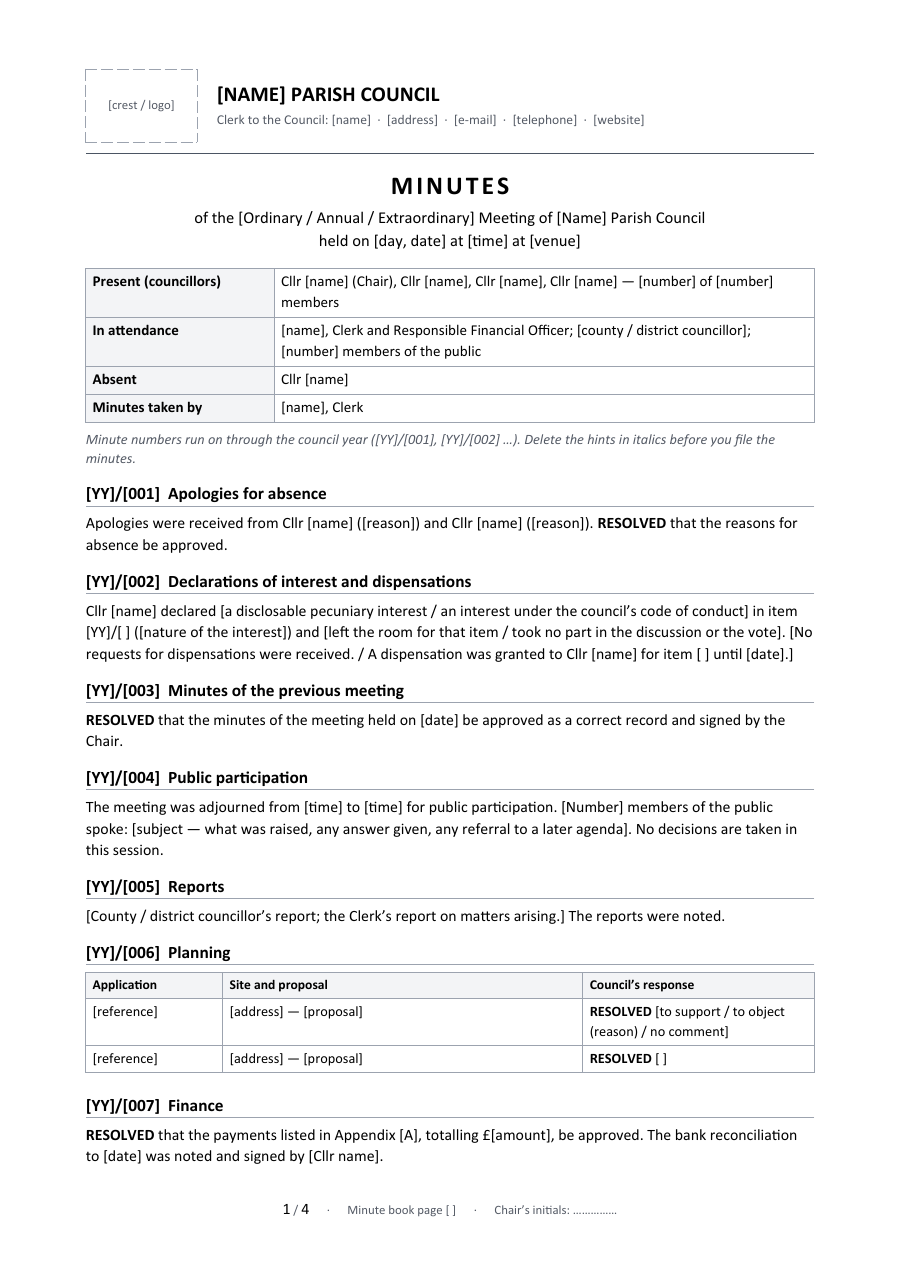
First page of the parish council minutes template: letterhead, attendance table and numbered minute items
Page 1 of 4 — the template, notes with sources and a filled-in example

What parish council minutes must show

The law says little about the form of the minutes and a lot about their content. The names of the councillors present are recorded; the minutes are signed by the person presiding at the same or the next suitable meeting; on loose leaves, every leaf is numbered and initialled (Local Government Act 1972, Schedule 12, paras 40–41).

Everything else — minute numbers, the word RESOLVED, the proposer and seconder, the public participation slot — is practice, and your standing orders decide it. The template follows the usual order of business; change it to match yours.

Write what was decided, not every word that was said. Each resolution should be clear enough that someone who wasn’t there knows what the council agreed, what it costs and who does what.

In the Word file
  • The minutes: attendance and numbered minute items, from apologies to the date of the next meeting
  • Wording for a recorded vote, equal votes and the Chair’s casting vote
  • The resolution to exclude the press and public
  • A notes page: what the minutes must show, and the provision behind each point
  • A filled-in example from an invented parish council
Download the template (Word)

Word (.docx) · 4 pages · no sign-up needed

Checklist

What to record, and why

Each point with the provision it comes from, as the law stands on legislation.gov.uk on 28 November 2026.

  1. Who was present

    The names of the councillors present are recorded. Add the Clerk, other officers and the number of members of the public.

    Source: LGA 1972 Sch. 12 para 40

  2. That the meeting was quorate

    No business is transacted unless at least one third of the whole number of members are present, and never fewer than three: 3 for a council of 7 or 9, 4 for 12, 5 for 13.

    Source: LGA 1972 Sch. 12 paras 12, 45

  3. Apologies, and approved reasons

    A councillor who attends no meeting for six consecutive months stops being a councillor, unless the council approved the reason before the six months ran out — so minute the approval.

    Source: LGA 1972 s. 85(1)

  4. Declarations of interest

    A councillor with a disclosable pecuniary interest that is not on the register discloses it to the meeting and takes no part in the discussion or the vote, unless a dispensation was granted. Minute who declared what, and who left the room.

    Source: Localism Act 2011 ss. 31, 33

  5. Every decision, and how it was made

    Questions are decided by a majority of the members present and voting. With equal votes, the person presiding has a second or casting vote — minute it as such.

    Source: LGA 1972 Sch. 12 para 39

  6. Recorded votes

    Voting is by show of hands unless your standing orders say otherwise. If any councillor asks, the vote is recorded to show how each councillor present and voting voted.

    Source: LGA 1972 Sch. 12 para 13

  7. Excluding the press and public

    Meetings are open to the public. For confidential business the council can exclude the public by resolution, stating the reason — minute the resolution.

    Source: Public Bodies (Admission to Meetings) Act 1960 s. 1(2)

  8. The Chair’s signature

    The person presiding signs the minutes at the same or the next suitable meeting; a minute signed this way is received in evidence without further proof.

    Source: LGA 1972 Sch. 12 para 41

The template is a starting point, not legal advice. The law and your council’s standing orders decide — where they set other wording, another order of business or other deadlines, they apply.

Majorities

How a parish council decides

Under the Local Government Act 1972, Schedule 12, as it stands on legislation.gov.uk on 28 November 2026. Your standing orders may add rules of their own.

  • Most questions

    Rulea majority of the members present and voting

    SourceSch. 12 para 39(1)

  • Equal votes

    Rulethe person presiding has a second or casting vote

    SourceSch. 12 para 39(2)

  • Quorum

    Ruleat least one third of the whole number of members, never fewer than three

    SourceSch. 12 para 12

  • How members vote

    Ruleby show of hands, unless standing orders provide otherwise

    SourceSch. 12 para 13(1)

  • Recorded vote

    Ruleon any member’s requisition, each member’s vote for or against is recorded

    SourceSch. 12 para 13(2)

  • Extraordinary meeting

    Rulecalled by the chairman, or by two members if the chairman refuses their requisition or does not act on it within seven days

    SourceSch. 12 para 9

Example: a council of 9 with 5 councillors present is quorate (its quorum is 3). If 2 vote for, 1 against and 2 abstain, the motion is carried — abstentions don’t count.

Common mistakes

Common mistakes

What auditors, residents and the next clerk trip over.

  • Minuting the debate instead of the decision

    Long paraphrases of who said what bury the resolution. Summarise the discussion; write the decision in full.

  • Decisions under any other business

    The summons has to specify the business to be transacted (Sch. 12 para 10(2)(b)). Treat any other business as information only and put a decision on the next agenda.

  • Vague resolutions

    “Agreed to look into the playground” is not a decision. Who does what, for how much, by when?

  • Not recording who left the room

    When a councillor leaves for an item because of an interest, minute when they left and when they came back.

  • Changing the minutes after they are signed

    Once the Chair has signed, the minutes stand. If something was wrong, correct it at a later meeting and minute the correction there.

  • Unnumbered loose pages

    Minutes kept on loose leaves need consecutively numbered pages, each initialled by the Chair (Sch. 12 para 41(2)).

Filled-in example

A filled-in example

An extract from the minutes of an invented parish council meeting.

Brackenmere Parish Council — minutes of the Ordinary Meeting, 10 November 2026

Present
Cllr Margaret Ellison (Chair), Cllrs Okafor, Whitlock, Hargreaves, Nair and Fenwick — 6 of 7 members; Laura Bennett, Clerk and RFO; 9 members of the public
26/101 Apologies
Cllr Marsh (work commitment). RESOLVED that the reason for absence be approved.
26/102 Interests
Cllr Fenwick declared an interest in item 26/105 (the site adjoins his home) and left the room for that item.
26/104 Public participation
Adjourned from 7.36pm to 7.50pm. Four residents raised speeding on Mill Lane (item 26/107).
26/105 Planning
26/01844/FUL, Orchard Barn, Mill Lane — barn to two dwellings. RESOLVED to object: the access is on a blind bend.
26/106 Finance
RESOLVED that the payments in Appendix A, totalling £1,284.60, be approved.
26/107 Speed indicator device
Proposed by Cllr Whitlock, seconded by Cllr Nair: buy a device for up to £2,950 from the general reserve. Recorded vote, requested by Cllr Okafor — for: Whitlock, Nair, Hargreaves; against: Okafor, Fenwick, Ellison.
Casting vote
The votes being equal, the Chair gave a casting vote against the motion, which was therefore lost.
Signed
By the Chair as a correct record at the meeting on 12 January 2027.

The council, the people and the amounts are invented. The Word file ends with the same example.

Download the template (Word)
With MinutesMaster

Minutes you don’t have to type up

You fill this template in by hand. MinutesMaster drafts the same minutes from the recording of the meeting: every speaker transcribed, then apologies, interests and each item with its resolution and the vote as it was announced.

You check and correct the draft — the council approves the minutes and the Chair signs them, as before.

  1. 1

    Record or upload

    Record the meeting on a phone or laptop, or upload the recording afterwards — up to 8 hours.

  2. 2

    A draft in your layout

    This structure or your council’s own template, with the transcript next to the draft for checking.

  3. 3

    Word and PDF

    Export the draft for circulation and the approved minutes for the minute book.

One vote from start to finish. Tap the phone and vote — or just watch.

Brackenmere Parish Council

Ordinary meeting · 10 November 2026

Chair’s console

Agenda

  1. Apologies and declarations of interest
  2. Minutes of the previous meeting
  3. 3Speed indicator device, Mill Lane
  4. 4Grass cutting contract for 2027
  5. 5Date of the next meeting

5 of 7 councillors present

Your phone · Cllr Nair

You are voting on

Speed indicator device, Mill Lane

The vote has not been opened yet.

The screen in the room

Ordinary meeting · 10 November 2026

Speed indicator device, Mill Lane

  • Ellison
  • Okafor
  • Nair
  • Whitlock
  • Hargreaves

5 of 7 councillors present

Agenda and attendance. The Chair sees the agenda and who is present; the recording runs in the background.

Sources

The legal statements on this page come from the Acts below, as published on legislation.gov.uk on the date shown. Laws change — check the current wording before you rely on a provision.

  1. [1]Local Government Act 1972, Schedule 12 and ss. 85, 228 (legislation.gov.uk) — read 2026-11-28
  2. [2]Public Bodies (Admission to Meetings) Act 1960, s. 1 (legislation.gov.uk) — read 2026-11-28
  3. [3]The Openness of Local Government Bodies Regulations 2014, SI 2014/2095 (legislation.gov.uk) — read 2026-11-28
  4. [4]Localism Act 2011, ss. 27, 31, 33 (legislation.gov.uk) — read 2026-11-28
FAQ

Frequently asked questions

What should parish council minutes include?
The names of the councillors present, apologies, declarations of interest and every decision with how it was made — plus the date, time and place, the public participation session and the date of the next meeting. The law requires the names of those present and the Chair’s signature; your standing orders set the rest.
Who signs parish council minutes, and when?
The person presiding at the meeting where they are approved — usually the next meeting — signs them (Local Government Act 1972, Sch. 12 para 41). On loose leaves, each page is numbered and initialled.
Does the Chair have a casting vote?
Yes. With equal votes, the person presiding has a second or casting vote (Sch. 12 para 39(2)). Minute it as a casting vote, with the result.
What is a recorded vote?
If any councillor asks, the vote is recorded to show how each councillor present and voting voted (Sch. 12 para 13(2)). Your standing orders may say when the request has to be made.
Can members of the public record the meeting?
Yes. While the meeting is open to the public, anyone attending may film, photograph, audio-record and report on it (Public Bodies (Admission to Meetings) Act 1960, s. 1(4)(d), added in 2014).
Who can see the minutes?
Any local government elector for the area may inspect the minutes and make a copy of them or an extract from them (Local Government Act 1972, s. 228(1)).
Can the minutes be drafted from a recording?
Yes. MinutesMaster transcribes the recording and drafts the minutes in the layout of this template, or your own, for the clerk to check. The council still approves them and the Chair signs.

Draft the next minutes from the recording

Record the meeting, get a draft in this layout, check it and export it to Word.

  • 3 free credits
  • No credit card
  • No AI training on your data

Last updated