Free Word template · England

Parish council agenda template, with the summons

A Word template for the summons to a parish or town council meeting in England, with the agenda in the usual order of business — apologies, interests, minutes, public participation, planning, finance, decisions — notes on the three clear days’ notice and a filled-in example.

Word (.docx) · 3 pages · no sign-up needed

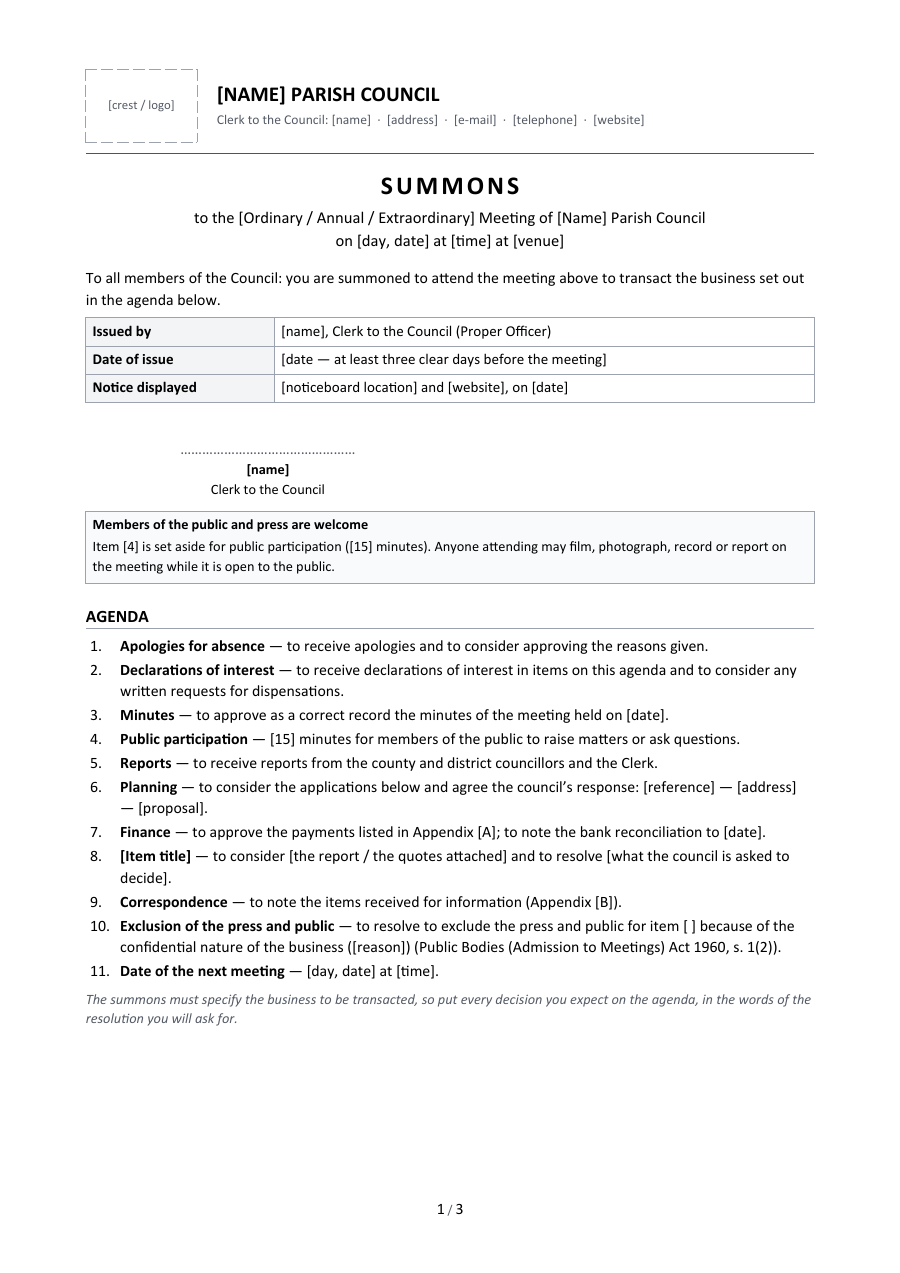
First page of the parish council agenda template: letterhead, the summons and the numbered agenda
Page 1 of 3 — the summons and agenda, notes with sources and an example

What the summons must say, and when it goes out

At least three clear days before the meeting, every councillor gets a summons that specifies the business to be transacted, and a notice of the time and place is fixed in a conspicuous place in the parish (Local Government Act 1972, Schedule 12, para 10(2)).

Because the business has to be specified, the agenda decides what the council can resolve. Word each item as what the council is asked to do — “to consider the quotes attached and resolve which to accept” — and send the papers with it. The order of business and the length of public participation are set by your standing orders.

In the Word file
  • The summons: to whom, when and where, issued by the Clerk
  • The agenda in the usual order of business, each item worded as what the council is asked to do
  • A note for the public on participation and reporting
  • A notes page: notice, meetings and interests, with the law behind each point
  • A filled-in example from an invented parish council
Download the template (Word)

Word (.docx) · 3 pages · no sign-up needed

Checklist

What the summons and agenda need

Each point with the provision it comes from, as the law stands on legislation.gov.uk on 28 November 2026.

  1. Three clear days

    The summons and the public notice go out at least three clear days before the meeting. Clear days are usually counted without the day of issue and the day of the meeting.

    Source: LGA 1972 Sch. 12 para 10(2)

  2. The business, specified

    The summons specifies the business to be transacted and is certified by the proper officer — usually the Clerk.

    Source: LGA 1972 Sch. 12 para 10(2)(b)

  3. To every councillor

    By post or left at the councillor’s home, or electronically to an address the councillor has agreed to.

    Source: LGA 1972 Sch. 12 para 10(2A)

  4. A public notice

    The time and place, fixed in a conspicuous place in the parish. Most councils put it on their website as well.

    Source: LGA 1972 Sch. 12 para 10(2)(a)

  5. Open to the public

    The meeting is open to the public, and anyone attending may report on it, including by filming and audio recording.

    Source: Public Bodies (Admission to Meetings) Act 1960 s. 1(1), (4)(d)

  6. How many meetings

    An annual meeting every year and at least three other meetings. The chairman can call an extraordinary meeting, and so can two councillors whose requisition the chairman refuses or ignores for seven days.

    Source: LGA 1972 Sch. 12 paras 7–9

The template is a starting point, not legal advice. The law and your council’s standing orders decide — where they set other wording, another order of business or other deadlines, they apply.

Majorities

How a parish council decides

Under the Local Government Act 1972, Schedule 12, as it stands on legislation.gov.uk on 28 November 2026. Your standing orders may add rules of their own.

  • Most questions

    Rulea majority of the members present and voting

    SourceSch. 12 para 39(1)

  • Equal votes

    Rulethe person presiding has a second or casting vote

    SourceSch. 12 para 39(2)

  • Quorum

    Ruleat least one third of the whole number of members, never fewer than three

    SourceSch. 12 para 12

  • How members vote

    Ruleby show of hands, unless standing orders provide otherwise

    SourceSch. 12 para 13(1)

  • Recorded vote

    Ruleon any member’s requisition, each member’s vote for or against is recorded

    SourceSch. 12 para 13(2)

  • Extraordinary meeting

    Rulecalled by the chairman, or by two members if the chairman refuses their requisition or does not act on it within seven days

    SourceSch. 12 para 9

Example: a council of 9 with 5 councillors present is quorate (its quorum is 3). If 2 vote for, 1 against and 2 abstain, the motion is carried — abstentions don’t count.

Common mistakes

Common mistakes

The ones that make a meeting start badly.

  • Counting the days wrong

    Three clear days don’t include the day the summons goes out or the day of the meeting. For a meeting on a Thursday, send it on the Sunday before at the latest.

  • Decisions under any other business

    The business has to be specified on the summons, so keep decisions off any other business and put them on the next agenda.

  • Items that don’t say what will be decided

    “Playground” tells nobody what the council will be asked. “To consider the three quotes attached and resolve which to accept” does.

  • Papers handed out on the night

    Councillors can’t weigh quotes they first see at the meeting. Send the papers with the summons.

  • Forgetting the public notice

    The summons to councillors is not enough: a notice of the time and place has to be displayed in the parish as well.

Filled-in example

A filled-in example

The summons to a meeting of an invented parish council.

Brackenmere Parish Council — summons to the Ordinary Meeting, 10 November 2026

Issued
Wednesday 4 November 2026, by Laura Bennett, Clerk — five clear days before the meeting
Displayed
Noticeboard by the Village Hall and the council’s website, 4 November 2026
Items 1–3
Apologies; declarations of interest; the minutes of 13 October 2026
Item 4
Public participation — 15 minutes
Item 5
Planning — 26/01844/FUL, Orchard Barn, Mill Lane: conversion of a barn to two dwellings
Item 6
Finance — to approve the payments in Appendix A (£1,284.60)
Item 7
Speed indicator device, Mill Lane — to consider the two quotes attached and resolve whether to buy a device for up to £2,950 from the general reserve
Item 8
Date of the next meeting — Tuesday 12 January 2027

The council, the people and the amounts are invented. The Word file ends with the same example.

Download the template (Word)
With MinutesMaster

Minutes you don’t have to type up

You fill this template in by hand. MinutesMaster drafts the same minutes from the recording of the meeting: every speaker transcribed, then apologies, interests and each item with its resolution and the vote as it was announced.

You check and correct the draft — the council approves the minutes and the Chair signs them, as before.

  1. 1

    Record or upload

    Record the meeting on a phone or laptop, or upload the recording afterwards — up to 8 hours.

  2. 2

    A draft in your layout

    This structure or your council’s own template, with the transcript next to the draft for checking.

  3. 3

    Word and PDF

    Export the draft for circulation and the approved minutes for the minute book.

One vote from start to finish. Tap the phone and vote — or just watch.

Brackenmere Parish Council

Ordinary meeting · 10 November 2026

Chair’s console

Agenda

  1. Apologies and declarations of interest
  2. Minutes of the previous meeting
  3. 3Speed indicator device, Mill Lane
  4. 4Grass cutting contract for 2027
  5. 5Date of the next meeting

5 of 7 councillors present

Your phone · Cllr Nair

You are voting on

Speed indicator device, Mill Lane

The vote has not been opened yet.

The screen in the room

Ordinary meeting · 10 November 2026

Speed indicator device, Mill Lane

  • Ellison
  • Okafor
  • Nair
  • Whitlock
  • Hargreaves

5 of 7 councillors present

Agenda and attendance. The Chair sees the agenda and who is present; the recording runs in the background.

Sources

The legal statements on this page come from the Acts below, as published on legislation.gov.uk on the date shown. Laws change — check the current wording before you rely on a provision.

  1. [1]Local Government Act 1972, Schedule 12 and ss. 85, 228 (legislation.gov.uk) — read 2026-11-28
  2. [2]Public Bodies (Admission to Meetings) Act 1960, s. 1 (legislation.gov.uk) — read 2026-11-28
  3. [3]The Openness of Local Government Bodies Regulations 2014, SI 2014/2095 (legislation.gov.uk) — read 2026-11-28
  4. [4]Localism Act 2011, ss. 27, 31, 33 (legislation.gov.uk) — read 2026-11-28
FAQ

Frequently asked questions

How much notice does a parish council meeting need?
At least three clear days: the summons to councillors and the public notice both go out three clear days before the meeting (Local Government Act 1972, Sch. 12 para 10(2)). Clear days are usually counted without the day of issue and the day of the meeting.
Who issues the summons?
The proper officer of the council — usually the Clerk — certifies the summons that goes to every councillor (Sch. 12 para 10(2)(b)).
Can the summons be sent by e-mail?
Yes, to a councillor who has agreed to receive it electronically at a particular address and has not withdrawn that consent; otherwise it goes by post or is left at their home (Sch. 12 para 10(2A)).
Can the council decide something that isn’t on the agenda?
The summons has to specify the business to be transacted, so a decision belongs on the agenda. Raise anything new under any other business for information, and put it on the next agenda.
What if a councillor didn’t receive the summons?
A summons that was not served on a councillor does not by itself make the meeting invalid (Sch. 12 para 10(3)) — but do send it to everyone.
How often must a parish council meet?
At least four times a year: the annual meeting and at least three other meetings (Sch. 12 paras 7 and 8).

Then draft the minutes from the recording

Record the meeting, get a draft of the minutes in your layout, check it and export it to Word.

  • 3 free credits
  • No credit card
  • No AI training on your data

Last updated